Setting up the logic for how calculations should be performed is handled by an equipment custom rule called "PIPETTE METHOD SETUP", which you can place on your Equipment or Template layout (see Update Layouts). It reads and saves settings into the following Specification entries in the IS_PIP table that has Text Value PIPETTE. If you have settings in extended attributes from an earlier version, launching PIPETTE METHOD SETUP will read those values and transfer them to the Specifications, if needed. | Table Entry | Text Value | | MODE | Text | | NUMBER SAMPLES | Numeric | | NUMBER SAMPLES2 | Numeric | | EVAP BLANK INTERVAL | Numeric | | COLLECT DATE BY | Text | | CALCULATE AFTER | Text | | USE CYCLE TIMER | Yes/No | | CYCLE MINUTES | Numeric | | CYCLE SECONDS | Numeric | | USE TEMPERATURE | Yes/No | | USE BAROMETRIC PRESSURE | Yes/No | | USE REL HUMIDITY | Yes/No | | USE DENSITY | Yes/No | | DENSITY | Numeric | | CHECK ACCURACY | Yes/No | | CHECK PRECISION | Yes/No | | CALC TYPE | Text | | CUBIC EXPANSION COEFF | Numeric | | CHANNELS | Numeric | | CHANNEL ROWS | Numeric | | CHANNEL SPACING | Text |
The Method Setup screen is shown below.
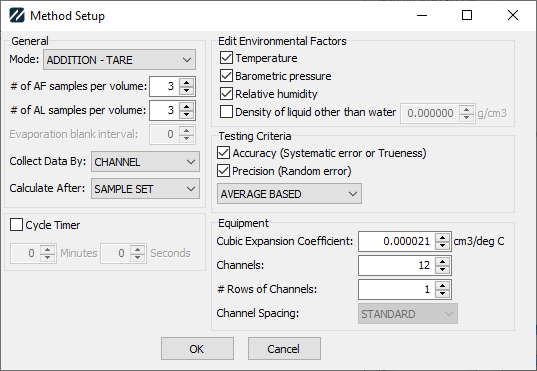
Mode is used to indicate how successive samples from the balance should be interpreted.
ADDITION: means you are adding volume to the balance without taring in between samples. The amount logged is the difference between the current and previous sample.
ADDITION - TARE: means you are adding volume to the balance and taring in between samples. The amount logged is the reading from the balance.
SUBTRACTION: means you are removing volume from the balance without taring in between samples. The amount logged is the difference between the previous and current sample.
SUBTRACTION - TARE: means you are removing volume from the balance and taring in between samples. The amount logged is the negative of the reading from the balance.
of AF Samples per volume: this is the default number of samples for As Found readings.
of AL Samples per volume: this is the default number of samples for As Left readings.
Evaporation blank interval: if not taring between samples, this determines how often to pause sampling to calculate the evaporation rate of the liquid. This is best used with the Cycle Timer option to ensure consistent evaporation rates.
Collect Data By: This has two options:
SAMPLE: by default, you will collect sample 1 across all channels before collecting sample 2
CHANNEL: by default, you will collect all samples for channel 1 before collecting samples for channel 2
Calculate After: This has two option:
EACH SAMPLE: This will cause accuracy, precision, and uncertainty to calculate after every sample. This can slow down performance, but give the tech earlier feedback if there's an issue.
SAMPLE SET: This will cause accuracy, precision, and uncertainty to only calculate when the last sample for a channel/volume is collected. This can speed up performance, but give the tech less feedback.
Cycle Timer: if checked, this will display a countdown timer that resets to the indicated minutes/seconds after every sample. This is mainly helpful with ADDITION and SUBTRACTION modes to ensure consistent evaporation, so the evaporation can be accounted for when collection samples.
Temperature: If checked, use the temperate from the event when calculating the Z-factor. Otherwise, use 70 F
Barometric Pressure: If checked, use the BP from the event when calculating the Z-factor. Otherwise, use 760 mm HG
Relative Humidity: If checked, use the RH from the event when calculating the Z-factor. Otherwise, use 70%
Density of liquid other than water: If checked, use the indicated value as the density. Otherwise, calculate the density of water based on the temperature.
Accuracy: Determine whether the Mean (AVERAGE BASED) or Max (INDIVIDUAL BASED) deviation from nominal will be used in calculating results.
Precision: Determine whether the Standard Deviation will be used in calculating results.
Cubic Expansion Coefficient: This is the Cubic Expansion Coefficient of the pipette, and is used in calculating the Y-value.
Channels: This is the number of channels in the pipette.
Rows of Channels: The number of rows the channels are arranged in.
Channel Spacing: For pipettes with multiple channels, it indicates STANDARD or 1/2 STANDARD spacing. When used with a multi-channel balance, 1/2 STANDARD collects readings by odds/evens instead of sequentially.