Data Collection
Data collection for as found/as left looks the same. Below is the form for RS232 collection.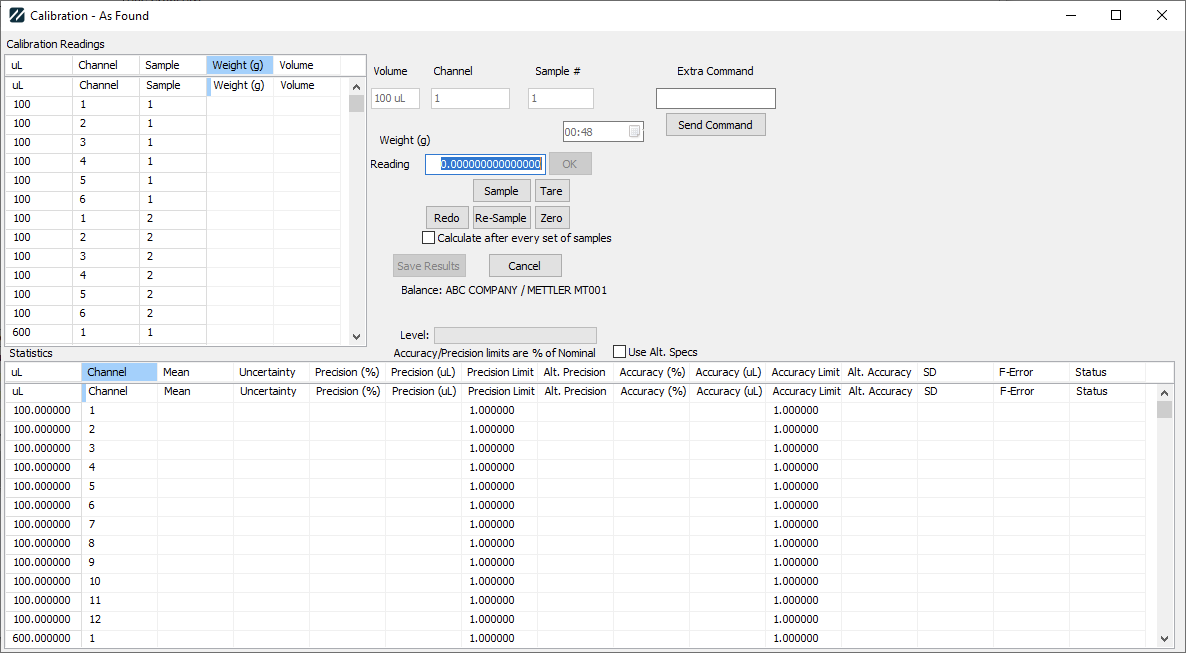
When the dialog is launched, the first thing it does is set up, according to the various settings in the Equipment Extended Attributes and the default test points.
The Calibration Readings grid has one row for each test point and sample and channel. The number of samples is in Extended Attribute NUMBER SAMPLES (defaults to 5). So 3 testpoints with 4 samples and 2 channels would result in 24 rows. uL comes from the test point description. Ch is always channel 1, Sp is the sample number for that test point.
The Statistics grid has one row for each test point. Summary statistics are calculated automatically as data is entered.
The following variables are used internally:
samples: Extended Attribute IS_PIP NUMBER SAMPLES (defaults to 5)
accuracy: Extended Attribute IS_PIP CHECK ACCURACY (defaults to false)
precision: Extended Attribute IS_PIP CHECK PRECISION (defaults to false)
cycle timer: Extended Attribute IS_PIP USE CYCLE TIMER (defaults to false)
mode: Extended Attribute IS_PIP MODE
calc type: Extended Attribute IS_PIP CALC TYPE
minutes: Extended Attribute IS_PIP CYCLE MINUTES
seconds: Extended Attribute IS_PIP CYCLE SECONDS
evap blank: Extended Attribute IS_PIP EVAP BLANK INTERVAL
initiate: true if mode isn't a " - TARE" mode.
evap: 0
evap counter: 0
Zfactor: from the Environmental Data screen
Run Type: AS LEFT or AS FOUND
Calculate after...: IS_PIP CALCULATE AFTER (defaults to unchecked/"set of samples")
If cycle timer is being used, then a countdown timer is displayed above the OK button for the reading to indicate when readings should be taken. Every new reading resets it to minutes:seconds.
Reading has twice the number of digits available as the maximum resolution on the test points.
If no balance is connected, the only way to enter readings is directly in the Calibration Readings grid, or in the Reading entry.
Note: A successfully connected balance does not mean the settings are correct. Other issues can block data from being read. When a reading is sent from the scale, an attempt is made to convert it to a number. So, for example, if it receives "N + 0.4498 g", That will be parsed as 0.4498. "N - 1.26 g" would be parsed as -1.26. That value is then placed into the Reading input, and the OK button is enabled. You can review it, modify it, or just press OK to accept it. A new reading will overwrite the current one.
When OK is pressed, several things happen:
1.If the Cycle Timer is visible, it is reset.
2.If the mode is "ADDITION" or "SUBTRACTION" and evap blank is not 0,
a.The evap counter is incremented
b.if the evap counter is the same as evap blank, it changes from "Reading" to "Evaporation Blank".
i.No sample should be taken at this time, as the amount of evaporation is instead being calculated.
ii.The next reading will be used to calculate evap, which will then be used as a modifier on future readings.
c.otherwise, it's set to "Reading".
3.The mode is examined to determine how to calculate the reading, if this is not an Evaporation Blank reading
a.ADDITION: current - previous + Evap
b.ADDITION - TARE: current
c.SUBTRACTION: current - previous - Evap
d.SUBTRACTION - TARE: -current
4.The final value of the reading is added to the next row, if this is not an Evaporation Blank reading
5.Results for the Statistics grid are recalculated
Note: you can directly modify the Weight column, but that will not affect what is considered the "current" row.
If more than one balance is connected
If the Sample button is pressed, the Sample command is sent to prompt the balance to send a reading.
If the Redo button is pressed, the Sample command is sent and the above logic happens in the current Weight instead of the next weight. This allows for redoing a bad reading from the scale.
If the Re-sample button is pressed, the Sample command is sent and the above logic happens in the current Weight instead of the next weight. This allows for redoing a bad sample.
Pressing Tare or Zero will send the respective command to the balance.
If the mode is ADDITION or SUBTRACTION, the Tare button is displayed. Pressing it sets "previous" to zero.
The Statistics grid is calculated as follows:
1.For each Calibration Reading, the Volume is set to the Weight * Z factor
2.For each test point (complete group of samples),
a.If precision and calc type="INDIVIDUAL BASED", then
i.for each weight, if abs(weight*Zfactor - nominal)*100 > precision * nominal, the test point fails
3.The individual weights are summed together as SumWeight,
4.MeanWeight = SumWeight / samples
5.MeanVolume = MeanWeight * Zfactor
6.SDVolume = sample standard deviation of the Volumes
7.Precision = SDVolume * 100 / MeanVolume
8.Accuracy = (MeanVolume - nominal)*100/nominal
9.F-Error = abs(Accuracy) + 2*SDVolume
10. if Samples > 1 then
a.Save Precision, SDVolume, and F-Error to the Statistics grid
b.otherwise, save NA for those values
11. if using accuracy as a criteria,
a.if abs(Accuracy) > Accuracy Limit, the test point fails
12.if using precision as a criteria and Calc Type="AVERAGE BASED
a.if samples <=1 or abs(precision) > Precision Limit, the test point fails
Test points without full data have the mean, precision %, accuracy%, SD, F-Error, and status cleared.
Test points with full data will calculate their uncertainties, as well, if configured.
If all data is entered, the Save Results button is enabled, otherwise it is disabled.
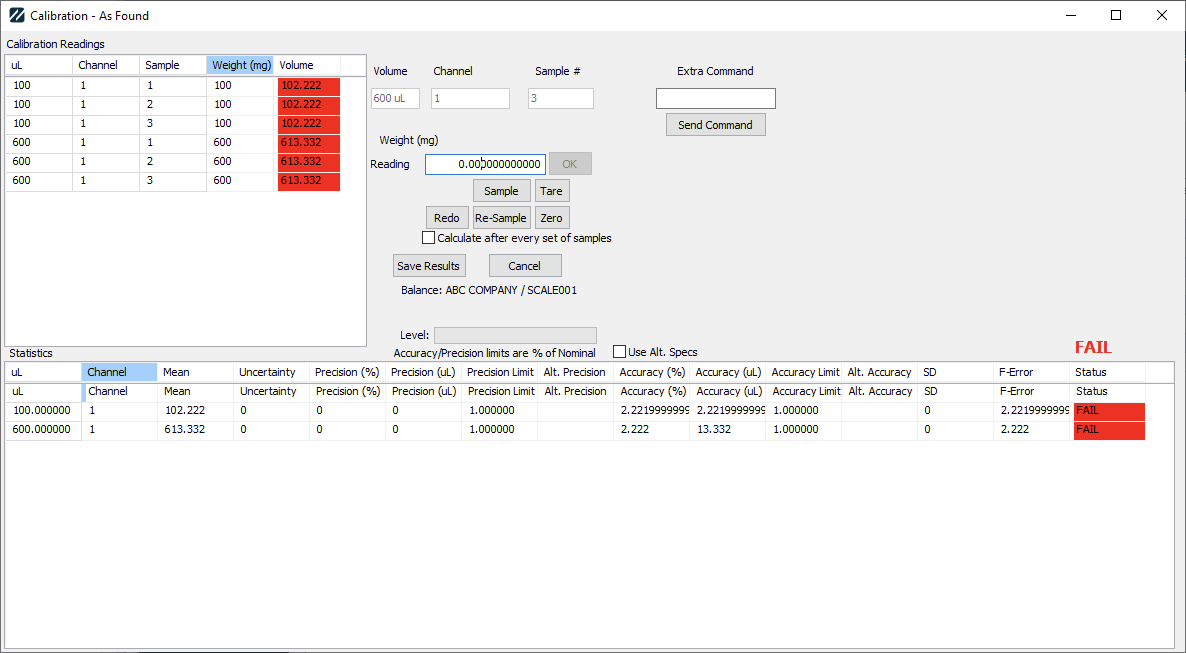
Additionally, Individual volumes that exceed the accuracy limit will have the volumes listed in the readings grid with a red background. The overall result will be listed above the statistics grid in green (PASS) or red (FAIL).
Buttons
If the Cancel button is pressed, the dialog is closed and all readings are discarded.
If the Save Results button is pressed, the dialog is closed, and all readings are saved to the Calibration Test Points(CALPNTS) and Calibration Test Points Extra(CALPNTSEXTRA) tables. For AS FOUND results, the field name on Calibration Test Points Extra is "AS FOUND #" where # is the test point number. Results are stored in the as found (1 or 0 for PASS or FAIL), Custom1, and custom3 fields for the test point. For AS LEFT results, the field name on Calibration Test Points Extra is "AS LEFT #" where # is the test point number. Results are stored in the as left (1 or 0 for PASS or FAIL), Custom2, and custom4 fields for the test point. Overall Pass/Fail/Adjusted results are then calculated for the entire event.
Extra Command
This allows you to send device-specific commands to the balance over RS232. Enter the command in the window, then click "Send Command". Refer to your balance's instruction manual for commands and what they do. This is only visible if connected to a device via RS232. |