Pipette Balance Setup
Pipette Balance Setup is similar to the Pipette Method Setup (also see Update Layouts). It saves its settings in the Specs (Uncertainty Attributes) tab. You must run Pipette Method Setup against a balance before you can automate taking readings from it in a Pipette calibration event. It reads and saves settings into the following Specification entries in the IS_PIP table that has Text Value BALANCE.
Note: If you are using Web Tier, you'll need to use Web Tier Tools to collect the data in the calibration event. You may want to use the Web Tier Tools version of Pipette Balance Setup from within the pipette cal event.
| Table Entry | Text Value | | AUTO_MODE | Text | | AUTOCOMMIT | Yes/No | | CHANNELS | Numeric | | COM_PORTS | Numeric | | DEVICE_TYPE | Text | | IP_ADDRESS | Text | | PORT | Numeric | | PORT/BAUD | Text | | PORT/DATA_BITS | Numeric | | PORT/FLOW_CONTROL | Text | | PORT/PARITY | Text | | PORT/PORT | Text | | PORT/STOP_BITS | Numeric | | PREFIX | Text | | SAMPLE | Text | | SUFFIX | Text | | TARE | Text | | TARE_CHECKS | Numeric | | UNIT | Text | | ZERO | Text |
The first step you need to take with the Pipette Method Setup is choose the device type. There are four options here:
RS 232: this is a balance that communicates via RS 232, with a single pan for collecting readings.
Sartorius SpeedCal: this is a Sartorius SpeedCal Mobile balance. It communicates via HTTP requests, and has 12 channels for readings, by default.
METTLER MCP 105: this is a Mettler Toledo MCP 105 multi-channel balance. It communicates over a single RS 232 connection, and has 12 channels for readings, by default.
MULTI-RS 232: this is a multi-channel balance, such as the Sartorius SpeedCal Classic, where each channel has its own RS 232 connection. For example, the Sartorius SpeedCal Classic has twelve channels for readings, each connected to one of twelve RS 232 connections.
There are three options for Auto Mode, as well:
None: no automatic taring/zeroing of the balance after readings are taken.
Tare After Reading: Sends a Tare Command after a reading is taken. This should not be used with a Pipette that is not using - TARE options in its Pipette Method Setup.
Zero After Reading: Sends a Zero Command after a reading is taken. This should not be used with a Pipette that is not using - TARE options in its Pipette Method Setup.
Tare Confirmation Attempts can range from 0 to 5. With 0, no attempt is made to confirm the balance returns 0 after tare/zero. For 1 to 5, it will attempt up to that number of times to ensure the balance is actually returning 0 after the tare.
Regardless of the Device type, you have two options to close the Pipette Balance Setup:
OK: Saves the settings to the Balance and closes.
Cancel: closes without saving changes to the Balance.
Depending on the device type, the options will vary as explained below:
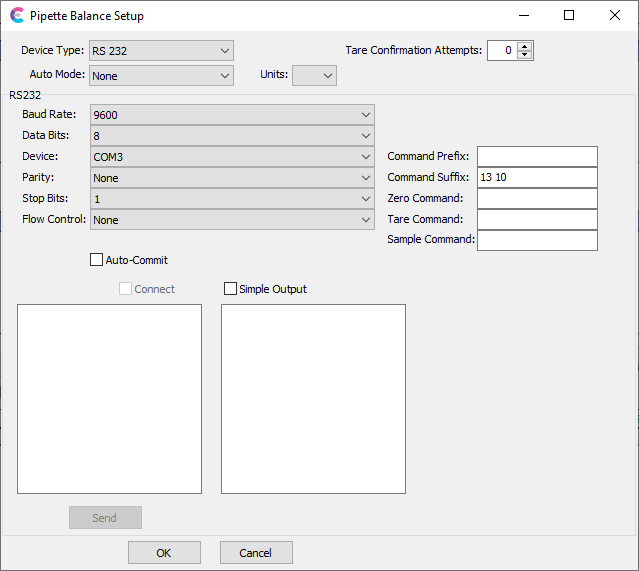
The RS 232 option allows you to select the RS232 connection settings (see Advanced RS232 for more details). Other options are described below:
Auto-Commit: if checked, readings received will be automatically added as a sample, and logic for calculating volume from weight applied. If unchecked, you will be able to preview readings before applying them.
Command Prefix: Some balances require a special prefix to indicate a command. Enter the decimal value for the ASCII characters to use as the prefix.
Command Suffix: Balances generally require a special character sequence to indicate the end of command. By default, this is CR LF (13 10). Enter the decimal values for the ASCII characters to use as the suffix.
Zero Command: Enter the plain-text command for Zeroing the balance, to enable sending a Zero command to the balance when collecting data.
Tare Command: Enter the plain-text command for Taring the balance, to enable sending a Tare command to the balance when collecting data.
Sample Command: Enter the plain-text command for Sampling the balance, to enable sending a Sample command to the balance when collecting data.
Connect: This allows you to connect to your balance and confirm the settings. You can type commands in the left-hand memo and click Send to transmit, with Prefix and Suffix applied. Responses will be shown in the right-hand memo.
Simple Output: This will suppress timestamps and Hex output, which can make confirming data easier at times.
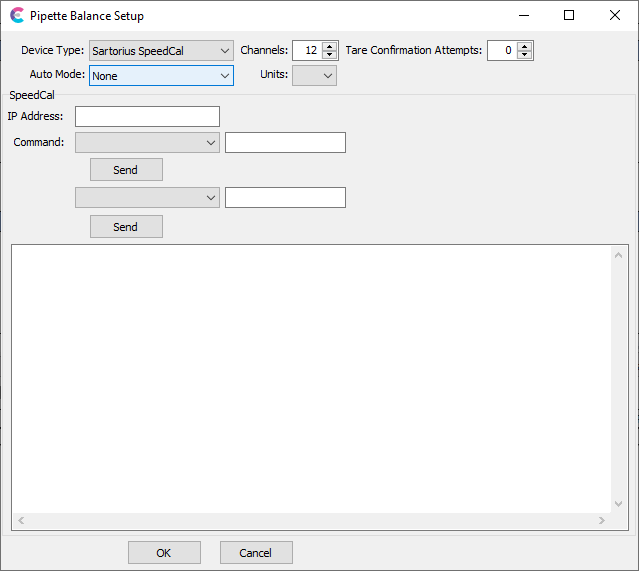
The Sartorius SpeedCal option only has two new selections, along with testing.
Channels: This allows you to select the number of channels the balance has. It defaults to 12.
IP Address: This allows you to indicate the IP address of the balance for sending commands.
Command: There are two dropdown boxes that you can use to select various commands for testing. Some commands have extra parameters you can enter in the edit box after the drop down. Click Send to issue the selected command. Results will be displayed in the memo below.
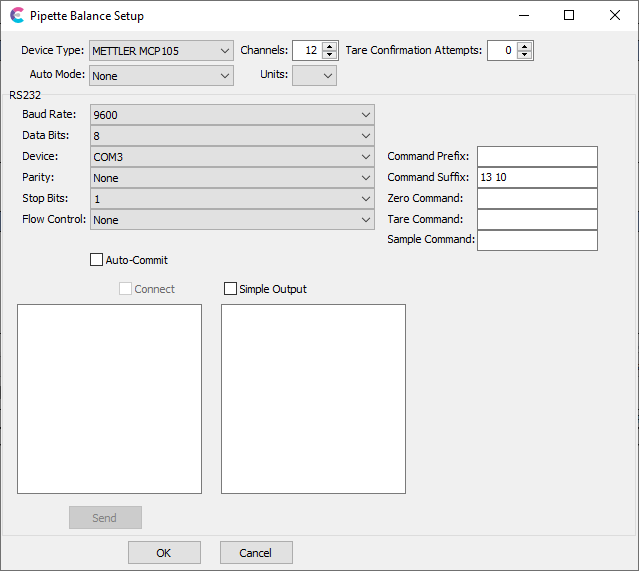
METTLER MCP 105 has the same options as RS 232, with one addition:
Channels: This allows you to select the number of channels the balance has. It defaults to 12.
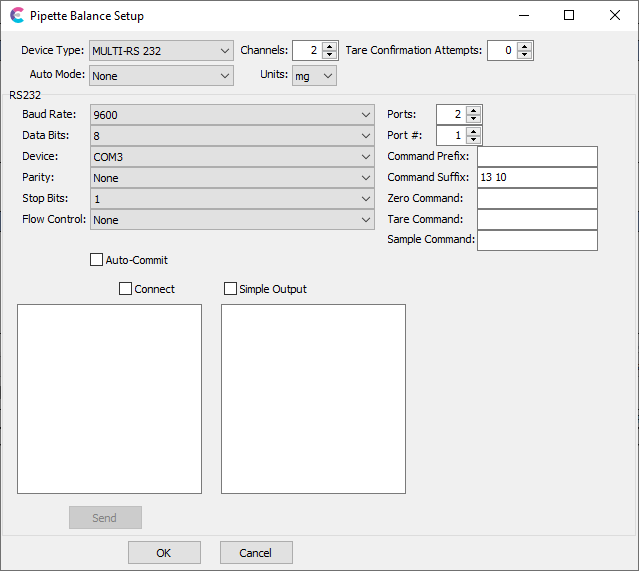
MULTI-RS 232 has the same options as RS 232, with three additions:
Channels: This allows you to select the number of channels the balance has. The minimum is 2.
Ports: The number of RS 232 ports the device uses. By default, this is the same as the number of channels. It is not recommended to have a different number of ports and channels.
Port #: The port currently being configured.